Magister Ludi’s seals and keys
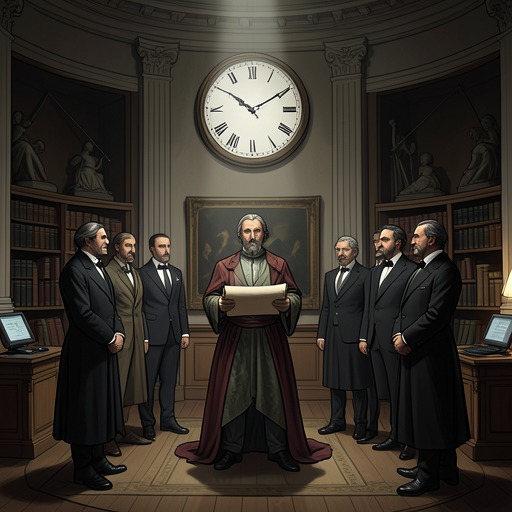
The Glass Bead GameThe Magister Ludi’s seals and keys are the insignia Joseph Knecht returns when he leaves his office, making a small casket the tangible focus of a conflict between personal vocation and institutional procedure. Their handover declares that Knecht considers his term as Magister Ludi finished; it does not, by itself, complete the formal resignation that Master Alexander is authorized to accept only through the prescribed process. The objects thus mark both an ending and the unresolved distance between an individual’s decision and the Order’s authority to recognize it.
Office and institutional authority
As Magister Ludi, Knecht holds an office with duties extending beyond the conduct of public Games. The Magister supervises players and schools and keeps watch over the Game’s further elaboration, while the World Commission of the Magisters determines whether new symbols and formulas enter its established stock. These arrangements make the office part of a larger system of custodianship: authority over the Glass Bead Game rests not simply in an individual’s skill, but in institutions that regulate its language and practice.
The Game itself is described as a highly developed secret language, drawing especially on mathematics and music to establish relationships among the contents of many scholarly disciplines. Its fixed structure permits an immense range of individual combinations, yet changes to the system are subject to strict control. Against this background, the insignia do more than identify a prestigious title: their return relinquishes a position embedded in a collective structure of oversight. Knecht also reassures Alexander that the insignia are intact and that affairs in the Players’ Village remain in order, separating his withdrawal from any suggestion that he has abandoned his responsibilities carelessly.
The handover to Alexander
Knecht brings a small casket to his meeting with Alexander and explains that he had been Magister Ludi until the previous day. By returning the seals and keys to Alexander as the Board’s representative, he considers himself liberated from the office. He says that Alexander is the only person he is bidding farewell to before leaving Castalia, and asks not only for recognition of the returned insignia but, in a separate appeal, for release from his oath as a member of the Order after they have discussed the matter fully.
Alexander does not treat the casket as a sufficient legal act. He points out that he cannot accept Knecht’s resignation on his own: at least a third of the Board must be present. The procedural objection makes the scene’s central distinction plain. Knecht can return the objects and declare his own departure, but his action does not automatically dissolve the office or the obligations attached to membership. The insignia carry the authority Knecht is surrendering; they cannot independently supply the institutional consent he needs.
Resignation and parting
In their later conversation, Knecht insists that he is not seeking to rescue his reputation or win the Board’s approval. He wants to avoid being judged a traitor or a madman, and explains that he took the step because he believed it incumbent upon him and bound up with his destiny. Alexander, while refusing to approve a personal right to violate the laws he represents, accepts Knecht’s withdrawal from the Order and agrees to pass the news of his voluntary resignation as Magister Ludi to the Board.
Knecht then gives Alexander further papers: his notes on conditions in Waldzell, especially the body of tutors, and recommendations concerning possible successors. The casket’s return is therefore accompanied by a practical transfer of information about the office and its future. Knecht’s act is not merely a rejection of Castalia’s authority; even while departing, he provides Alexander with materials intended to help the institution continue its work.
The farewell remains emotionally unsettled. Knecht asks Alexander to shake hands, then supposes he must forgo it; he tells him that Alexander has always been especially dear to him and that his feelings have not changed. Alexander appears for a moment to consider extending his hand, but only inclines his head and lets Knecht go. The seals and keys have passed back to the Order’s representative, while affection between the two men survives the break without erasing it.
Meaning of the insignia
The handover concentrates an institutional transition into a visible, bounded object: the casket can be placed on a table, inspected, and received, while the consequences of resignation remain subject to deliberation. This contrast echoes the Glass Bead Game’s own relation between a fixed system and individual action. Its established signs and rules are guarded by commissions and archives, yet the form allows players many different courses of play. Knecht’s departure similarly takes place within established forms even as it challenges the expectation that his service must continue.
The insignia also distinguish relinquishing authority from settling every obligation. Knecht returns the symbols of his Magister’s office first, then asks for release from his Order oath; Alexander’s response confirms that the two matters cannot be collapsed into one gesture. By the time Alexander accepts Knecht’s withdrawal and promises to report the resignation, the casket has already announced a decision that the institution can acknowledge but does not control at its origin. The returned seals and keys therefore stand at once for the authority Knecht gives up, the formal process that outlasts the handover, and the personal bond with Alexander that remains after their shared institutional life ends.